If you’ve ever searched for Invoice Discounting, Bill Discounting, Vendor Finance, or Factoring, you’ve probably noticed something.
Different banks. Different NBFCs. Different fintechs.
But very similar products.
This often creates confusion.
Let’s simplify the terminology.
Let’s Start with one question – Are these terms similar ?
Who needs the money?
There are only two sides to every trade transaction.
1. The Seller wants to receive payment early.
or
2. The Buyer wants additional time to make payment.
Everything else is built around these two requirements.
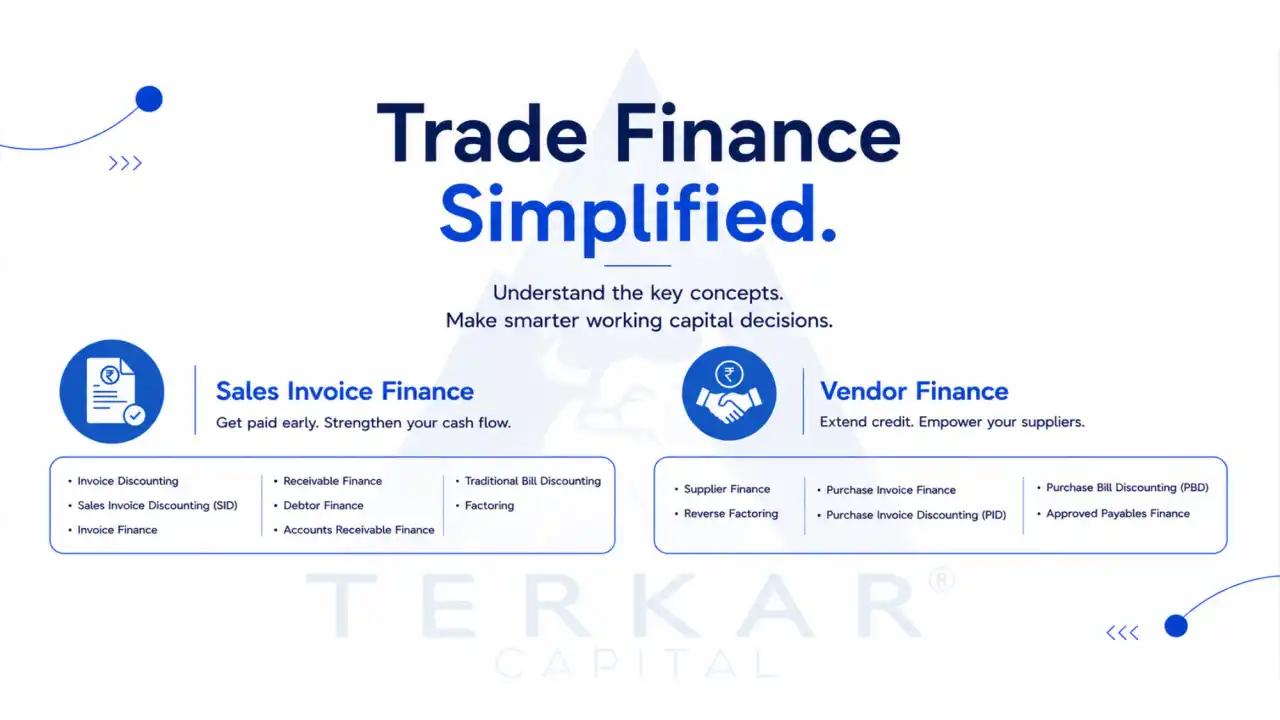
1. Sales Invoice Finance (Seller Side)
This is financing against invoices already raised on customers.
The objective is simple.
Convert receivables into immediate working capital.
Primary Product
Common market terms include:
• Sales Invoice Discounting (SID)
• Invoice Finance
• Receivable Finance
• Accounts Receivable Finance
• Debtor Finance
• Traditional Bill Discounting
These terms are often used interchangeably in the market.
However, the underlying objective remains the same.
Finance against outstanding sales invoices.
Related Product
Factoring
Factoring belongs to the same family but is not identical to Invoice Discounting.
In many cases, the financier may also:
• Purchase receivables
• Manage collections
• Offer additional debtor management services
Depending on the structure, the financier may even assume part of the credit risk.
2. Vendor Finance (Buyer Side)
This is financing for businesses that have already received goods or services.
Instead of the buyer paying immediately, a financing institution pays the supplier.
The buyer then repays the financier as per agreed credit terms.
Common market terminology
• Purchase Invoice Finance (PIF)
• Purchase Invoice Discounting (PID)
• Purchase Bill Discounting (PBD)
• Supplier Finance
• Reverse Factoring
• Approved Payables Finance
Although the terminology differs, the commercial objective remains the same.
Provide suppliers with faster payments while extending credit to buyers.
A simple way to remember
Sales Invoice Finance
Seller needs funds.
↓
Finance against receivables.
Vendor Finance
Buyer needs credit.
↓
Finance against payables.
Why does this matter?
Understanding the terminology helps businesses:
• Compare funding solutions more effectively
• Evaluate lender offerings objectively
• Avoid assuming that different names always mean different products
• Identify the right financing structure for their working capital cycle
In corporate finance, many products are marketed under different names.
Understanding the underlying structure is often more valuable than remembering the terminology.
Knowledge creates better financial decisions.