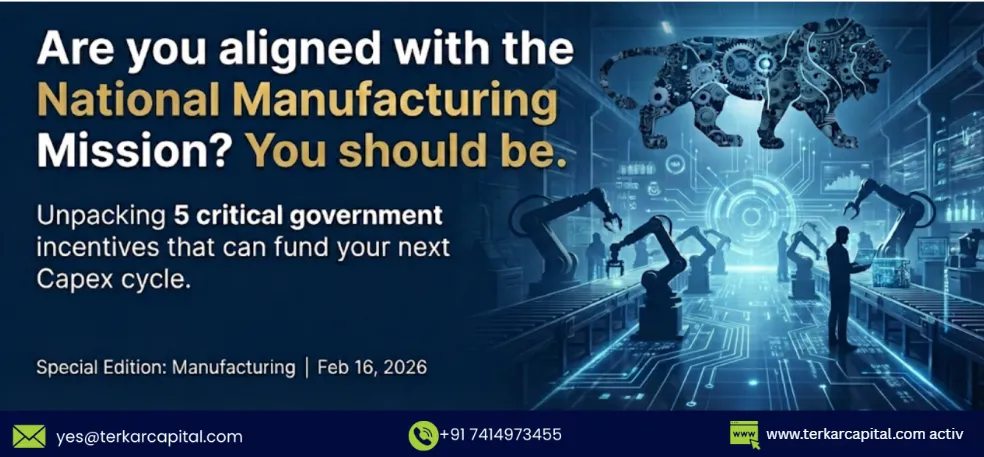
The government’s recent push under the National Manufacturing Mission isn’t just about policy papers; it’s about capital. With the Union Budget 2026-27 emphasizing scaling up manufacturing in 7 strategic sectors and the introduction of new credit guarantees, the landscape for Capex funding has shifted.
But the question remains: Is your balance sheet aligned to take advantage of these incentives?
At Terkar Capital, we analyzed the latest policy updates and identified 5 Critical Incentives that every Director and CFO must know before planning their next expansion.
1. The Capex Game-Changer: MCGS-MSME
For years, the “collateral gap” stopped mid-sized units from buying high-end machinery. That gap just got bridged.
- The Update: The Mutual Credit Guarantee Scheme (MCGS / CGTMSE ) now provides 60% guarantee coverage for machinery loans up to ₹100 Crores.
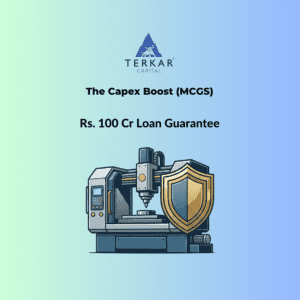
- The Impact: This is massive. Previously, CGTMSE capped out at ₹5 Cr. Now, manufacturers aiming for serious scale (₹50 Cr – ₹100 Cr projects) can access Term Loans with significantly reduced collateral requirements.
- Terkar Insight: Don’t use your working capital limits for this. Structure a specific Term Loan under MCGS to keep your CC limits free.
2. PLI 2.0: The Window is Open
The Production Linked Incentive (PLI) scheme has evolved. It’s no longer just for mobile phones.
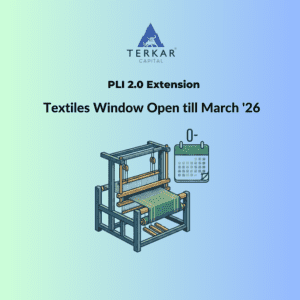
- The Update: The application window for Textiles (Technical Textiles & MMF) has been extended till March 31, 2026. Additionally, the outlay for Electronic Components has been increased to ₹40,000 Cr.
- The Impact: If you are in the textile or electronics supply chain, you are leaving money on the table if you aren’t claiming these production-linked cashbacks.
- Terkar Insight: Banks are now viewing “PLI Approval” as a strong credit comfort. If you are PLI-approved, your interest rate negotiation power increases instantly.
3. The "New" MSME: Bigger Limits, Same Benefits
Are you worried about “outgrowing” your MSME status? The definition has evolved to match India’s growth.
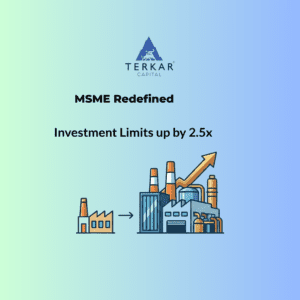
- The Update: Effective April 2025, the investment and turnover limits for MSME classification have been revised upwards (Investment limits raised by 2.5x).
- The Impact: You can now invest more in Plant & Machinery (up to ₹125 Cr for Medium Enterprises) without losing your “Priority Sector Lending” status.
- Terkar Insight: This allows you to pursue aggressive Capex without the fear of losing MSME interest subvention benefits.
4. Sector Specific: Biopharma & Semiconductors
The government is picking winners, and they are backing them with hard cash.
- The Update: Biopharma SHAKTI: A ₹10,000 Cr outlay to support biologics and biosimilars.
- ISM 2.0 (Semiconductors): Focus shifting to equipment and materials, meaning the supply chain vendors are now in focus.
- The Impact: If you are a vendor to these industries, your “Anchor” is strong. This opens up opportunities for Vendor Finance and Supply Chain Funding.
5. Quality Pays: ZED Certification
Sustainability is now a financial metric.
- The Update: The ZED (Zero Defect Zero Effect) scheme now offers higher subsidies on certification costs (up to 80%) and financial assistance for technology upgradation (up to ₹3 Lakhs).
- The Impact: ZED certification is becoming a prerequisite for becoming a vendor to large PSUs and Defence units.
- Terkar Insight: ZED Certified units often get a 0.50% concession on interest rates from select PSU banks.
THE TERKAR VIEW
Policy incentives are fuel, but your business structure is the engine.
Many manufacturers try to access these schemes with a generic loan application and get rejected. Why? Because the Financial Structuring doesn’t match the Policy Criteria.
We don’t sell loans. We structure your eligibility.

If you are planning an expansion in 2026, let’s ensure your debt structure is aligned with these government missions.
Stay Ahead of the Market
Get these updates directly on Email. No spam, just critical financial alerts.
Enjoying our insights? Never miss an update on Google Discover or Google Reads. ➜