Disclaimer: Official communication is sent only via emails from @terkarcapital.com; Please note that we do not offer digital lending nor do we charge any advance fees.
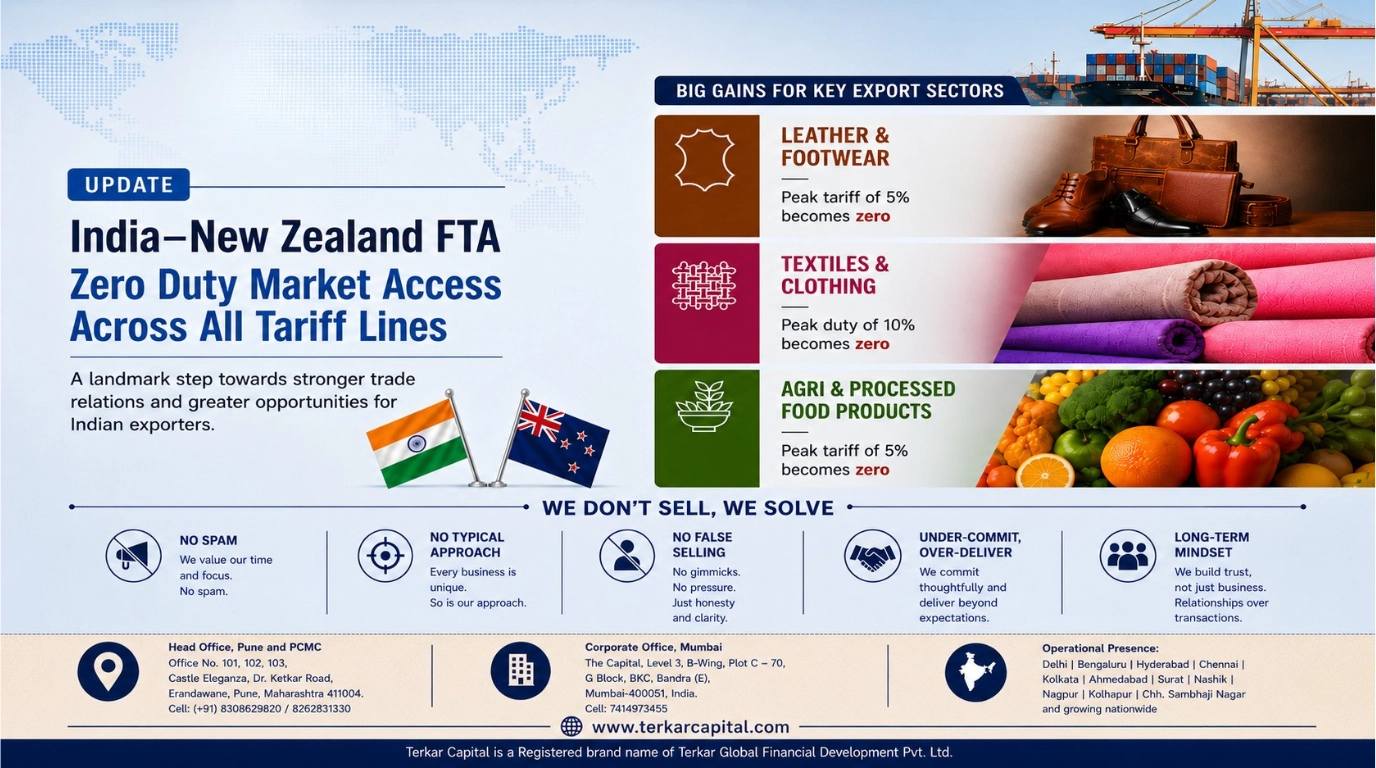
The recently signed Free Trade Agreement between India and New Zealand is more than just macroeconomic news it is an immediate operational trigger for Indian businesses. With a projected $20 Billion investment influx and lowered tariffs on specific agricultural imports, supply chain dynamics are shifting rapidly.
To capitalize on this, growth-stage companies must look beyond the headlines and audit their capital structures. Here is where the opportunity lies:
Highlights
1. Scaling Import Volumes via Trade Finance:
As specific imports (like kiwis and apples) become cheaper, domestic FMCG and agribusiness volumes will surge. Scaling these lines without choking your daily liquidity requires disciplined financial architecture. Utilizing optimized Letters of Credit (LC) and Bank Guarantees (BG) allows businesses to capture larger market shares while keeping their cash flows intact.
2. Capacity Expansion & The Dilution Shield:
A $20 Billion investment creates massive ripple effects across allied manufacturing and service sectors. To absorb new contracts, rapid capacity expansion is required. However, funding long-term assets with short-term cash is the fastest route to a liquidity crisis. Securing tailored Debt Instruments, such as Machinery Refinance or enhanced Working Capital limits, allows founders to scale aggressively while retaining 100% of their equity.
Global trade opportunities demand an efficient and well-organized fund flow system.
Shailesh is a specialist in unsecured business funding and MSME-focused credit solutions. With deep expertise in CGTMSE-backed financing and collateral-free lending structures, he helps entrepreneurs unlock growth capital without diluting ownership.
His work primarily focuses on enabling startups, SMEs, and emerging businesses to secure structured debt solutions tailored to cash flow strength and credit profile. Through strategic funding advisory and risk-aligned loan structuring, Shailesh ensures businesses gain access to timely capital for expansion, stabilization, and long-term sustainability.
Terkar Capital is a registered brand of Terkar Global Financial Development Pvt Ltd, an Investment Banking Firm with a national footprint. We work extensively with professionals and businesses of all sizes to arrange debt funding instruments.