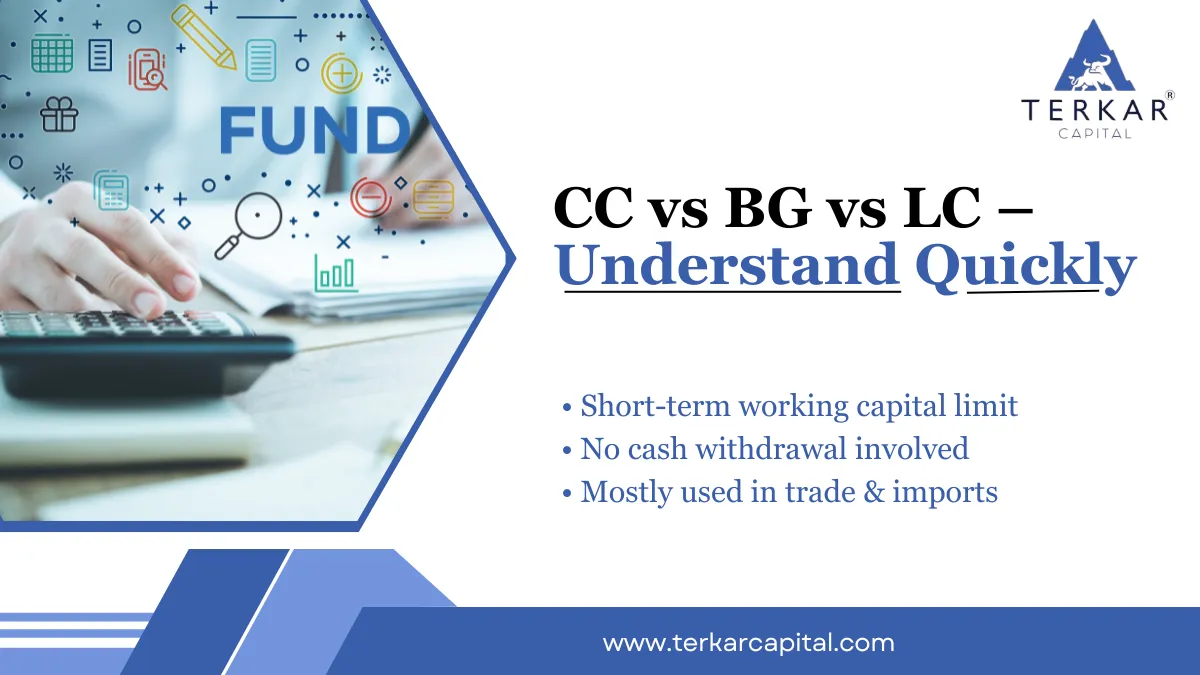
Many business owners use terms like Cash Credit (CC), Bank Guarantee (BG), and Letter of Credit (LC) as if they’re all just “loans.”
They’re not.
These are credit facilities, each created for a very specific business purpose. Knowing the difference helps businesses:
- Choose the right facility
- avoid unnecessary interest or charges
- manage cash flow and risk more effectively
Let’s break this down in simple, practical terms.
1. Cash Credit (CC): Keeping Daily Operations Moving
What it really is: Cash Credit is a revolving working capital facility.
Instead of receiving a lump-sum loan, the bank provides a limit. You can withdraw funds as needed, repay them, and reuse the same limit.
Best suited for:
- Manufacturers
- Traders and wholesalers
- Businesses with inventory cycles
- Companies with regular operational expenses
Why businesses prefer CC:
- Interest is charged only on the amount actually used
- Flexible access to funds
- Ideal for bridging day-to-day cash flow gaps
Key takeaway: CC helps run the business smoothly it’s not meant for long-term investments or asset purchases.
2. Bank Guarantee (BG): Building Trust Without Using Cash
What it really is: A Bank Guarantee is not cash funding.
It’s a commitment given by the bank on your behalf, assuring a third party that the bank will step in if you fail to meet a payment or performance obligation.
Best suited for:
- Contractors and infrastructure companies
- Businesses bidding for tenders
- Vendors dealing with large corporates or government bodies
Common use cases:
- Tender guarantees
- Performance guarantees
- Security deposits
Why businesses use BGs:
- Enhances credibility with clients
- Makes large contracts possible
- No immediate cash outflow
Key takeaway: BG strengthens trust and credibility not liquidity.
3. Letter of Credit (LC): Making Trade Safer for Buyers and Sellers
What it really is: A Letter of Credit is a trade finance tool.
The bank assures the supplier that payment will be made once agreed conditions are met such as delivery of goods or documents.
Best suited for:
- Importers and exporters
- Manufacturers sourcing raw materials
- Businesses working with new or overseas suppliers
Why businesses rely on LCs:
- Suppliers get payment assurance
- Buyers receive goods as per the agreed terms
- Reduces counterparty and trade risk
Key takeaway: LC enables secure trade, it’s not a working capital facility.
4. Choosing the Right Facility Makes a Real Difference
Each facility solves a different problem:
- CC → For daily operations and cash flow
- BG → For contracts, tenders, and performance commitments
- LC → For safe and structured trade transactions
Using the wrong facility can:
- increase financing costs
- create unnecessary cash flow pressure
- Impact future banking eligibility
5. Final Thought
CC, BG, and LC aren’t interchangeable. They’re tools and every tool works best when used for the right job.
Understanding these facilities helps businesses operate efficiently, manage risk better, and plan funding more strategically.
Stay Ahead of the Market
Get these updates directly on Email. No spam, just critical financial alerts.
Enjoying our insights? Never miss an update on Google Discover or Google Reads. ➜